Is DYNVOLT a BESS EMS?+
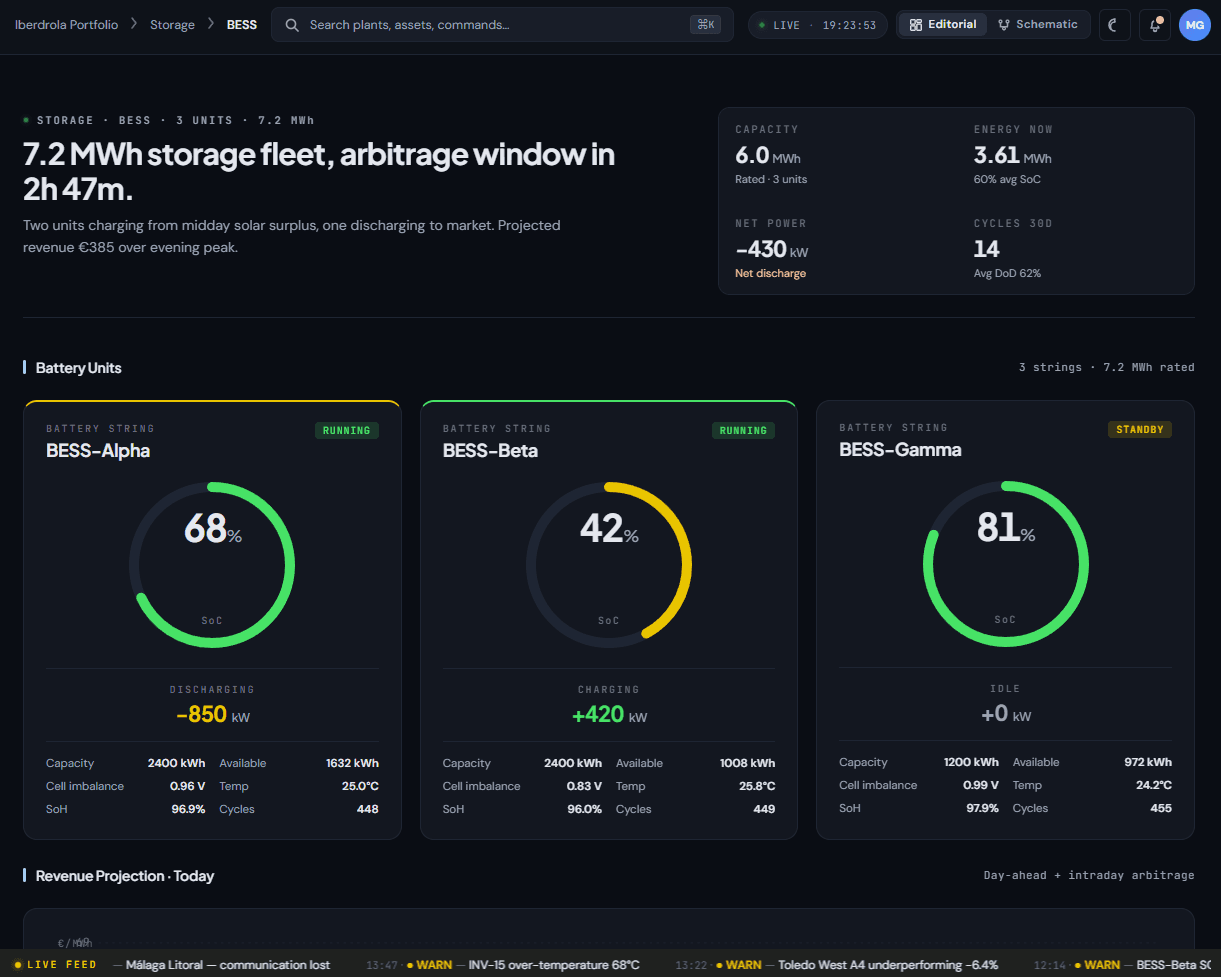
Yes — DYNVOLT is the EMS (energy management system) for utility-scale battery storage: above the PCS, below the trading desk. It owns the dispatch decision, writes active and reactive setpoints to the PCS over Modbus TCP, enforces the warranty envelope as hard constraints, and never overrides the BMS safety layer.
What is BESS optimization?+
BESS optimization is the dispatch software layer that decides — against prices, forecasts, and constraints — which revenue stream a utility-scale battery should serve: day-ahead arbitrage, intraday, balancing reserves, imbalance settlement, or capacity markets. A serious optimizer co-optimizes across these simultaneously rather than running each as a separate rules-based loop, inside the warranty envelope the asset owner defines.
What revenue streams does DYNVOLT optimize?+
Energy arbitrage (day-ahead and intraday), imbalance settlement, and ancillary reserves (aFRR / FCR / mFRR) — modelled in a single dispatch model that respects state-of-charge, cycle budget, thermal envelope, and grid-code limits.
Is the optimizer cycle-cost aware?+
It is the optimizer milestone we are building right now: pricing degradation as a marginal cost inside the objective. Today, degradation is handled as hard constraints — cycle count, depth of discharge, rate limits and thermal derating are enforced so the optimizer cannot schedule a breach — and the cost-aware objective ships on top of that foundation, not instead of it.
How is DYNVOLT different from a generic EMS or an arbitrage-only optimizer?+
A generic EMS dispatches against rules — it doesn't see prices or forecasts. An arbitrage-only optimizer captures day-ahead spreads but ignores balancing reserves, imbalance, and co-located solar. DYNVOLT models the full revenue-stacking problem in one optimization, warranty-bounded by construction.
Can it co-optimize with co-located solar?+
Yes — PV+BESS co-optimization is a first-class feature. Clipping recovery, ramp-rate compliance, curtailment hedging, and self-consumption are dispatched against a single envelope across PV and storage rather than as separate workflows.
Which BMS / PCS systems are supported?+
One BESS family is implemented at register level — ESMU and PCS maps, alarm decode — awaiting hardware for validation. Additional BMS and PCS families are an integration cycle each; we will scope the effort before you commit. The platform writes setpoints to the PCS — it does not replace the BMS.
How fast is the aFRR signal response?+
Fast-loop ancillary response is a design target of the edge-first architecture. Measured response figures are published once there is hardware to measure them on; until then we quote design targets as design targets, not as results.
Do you provide an audit trail for dispatch decisions?+
Every dispatch decision is logged with the price forecast, production forecast, state-of-charge, and constraints that drove it. Compliance teams, lenders, and warranty insurers can reconstruct any cycle on demand.