PLATFORM / 02 / AI FORECASTING

Tomorrow's revenue, today.

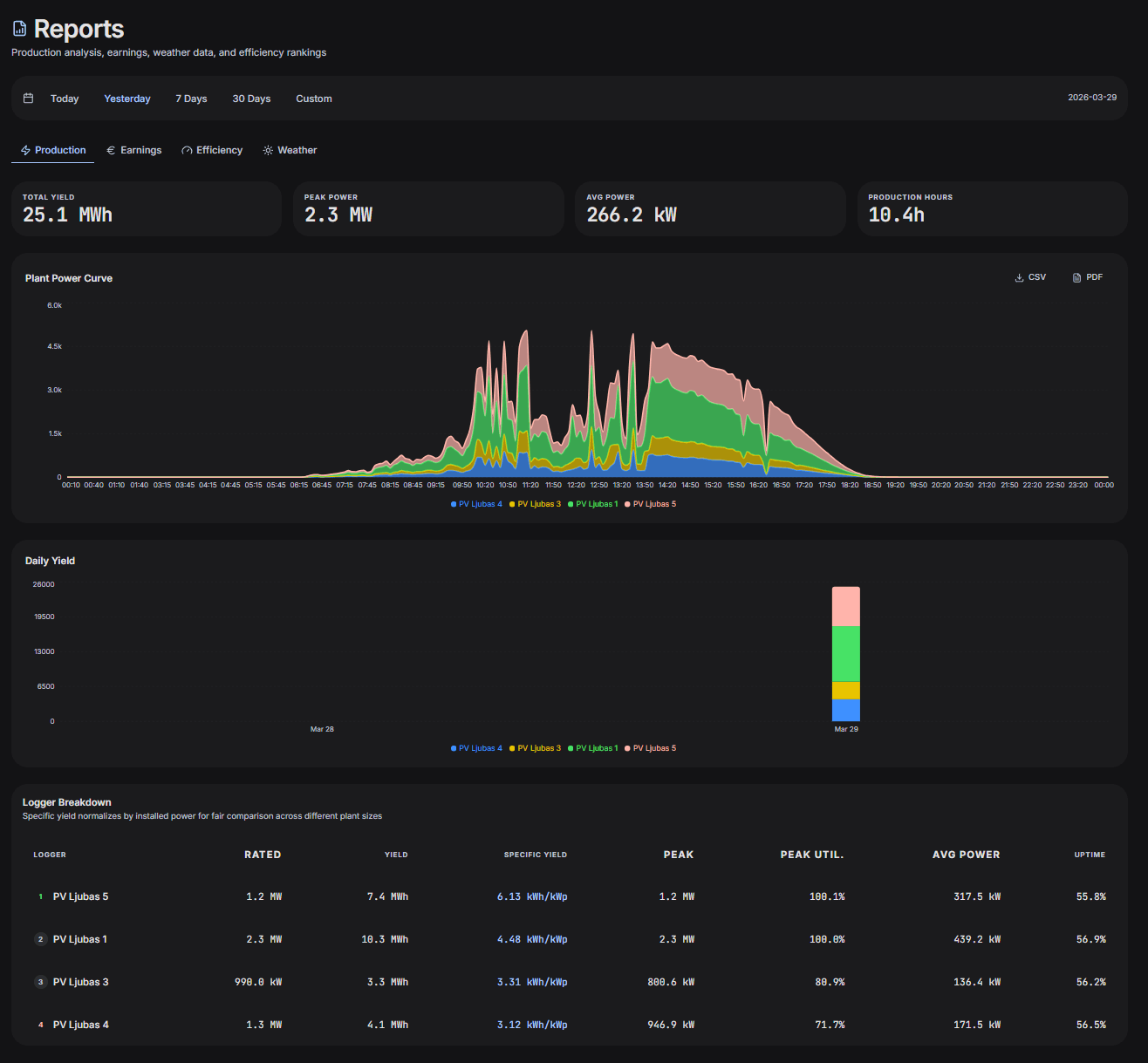
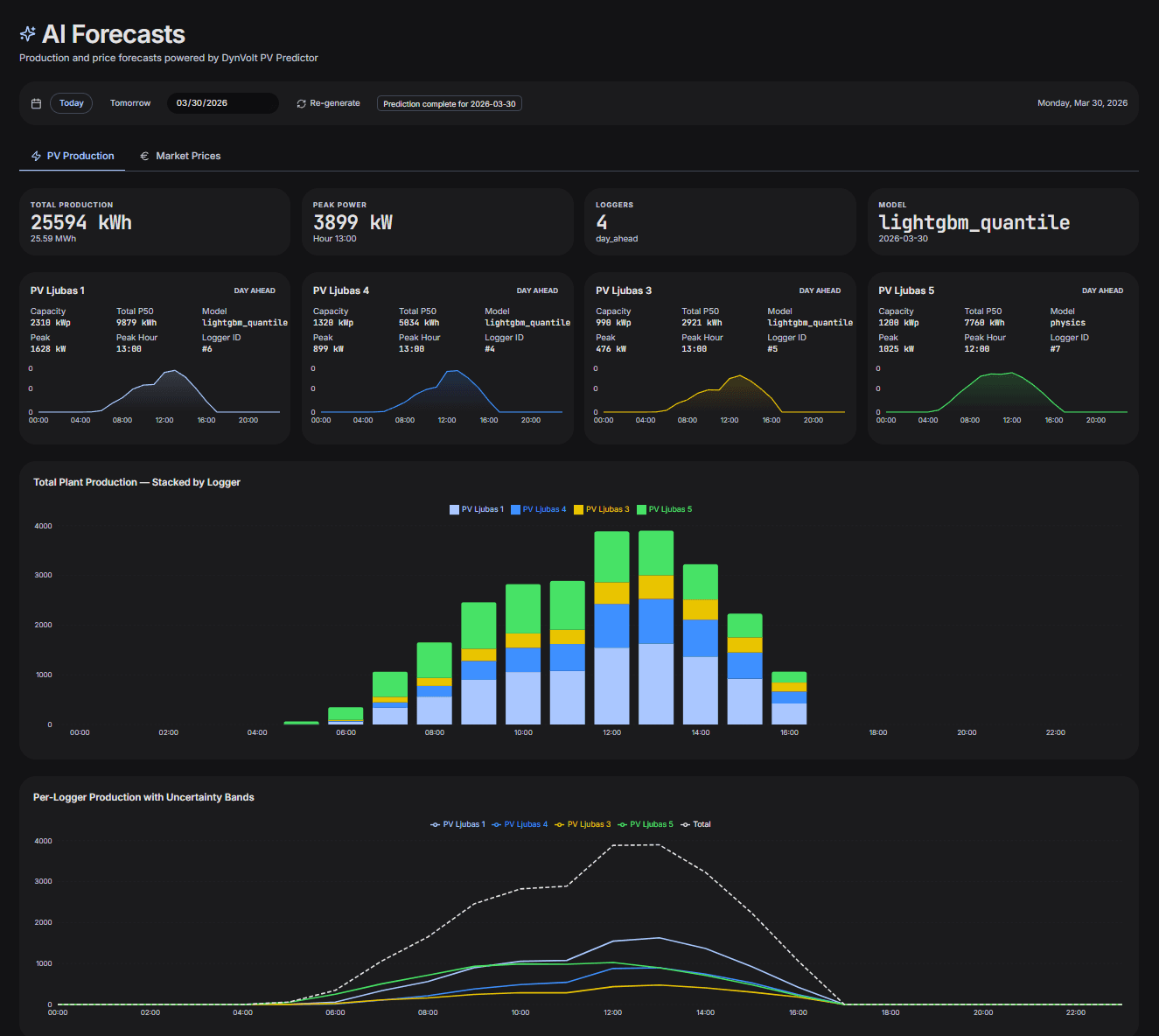
DYNVOLT forecasts production day-ahead at 8.32% nMAE — measured on the forecasts we actually issued, not a backtest, and published in full. P10/P50/P90 bands let you bid the day-ahead market with risk-adjusted curves, not single-point estimates.

8.32%
Day-ahead nMAE
113 days
Issued forecasts scored
+0.33
Skill vs persistence
P10–P90
Published bands
DUAL FORECAST ENGINE

Two forecasts. One bid envelope.

Solar revenue is a product of how much you produce and what the market pays. Most platforms predict one. DYNVOLT predicts both — and stitches them into a single risk-adjusted dispatch signal so traders bid against an actual P&L distribution.

FORECAST · A
PV Production
  • · Per-plant P10 / P50 / P90
  • · 15-min & hourly resolution
  • · Cloud + soiling + temp model
  • · Rolls up across portfolios
FORECAST · B
Power Prices
  • · Day-ahead & intraday curves
  • · Cross-border spread signals
  • · Imbalance settlement curves
  • · Confidence bands per hour
dispatch · production × price
DYNVOLT — production and price forecasts with P10/P50/P70/P90 confidence bands
FOR ENERGY TRADERS

Nominate the whole book. Not one plant at a time.

A trader managing eight owners across four bidding zones gets one rolled-up forecast per zone — already netted, already imbalance-priced, already in the format the BRP needs to nominate.

 PV PORTFOLIO · DAY-AHEAD ZONE          08:23 · GATE -216min
ILLUSTRATIVE CONSOLE — portfolio figures are examples
─────────────────────────────────────────────────────────────────
owners ..........  4   plants ........  12   total ......  18.6 MWp

DELIVERY DAY....................................  SUN 10-MAY-2026
SEGMENT.............  Day-Ahead Market (ПДО/DAM)  –  Full Day D+1
GATE CLOSES....................................  12:00 CET  (D-1)
IRRADIANCE INDEX.........  0.84  (clear sky ratio, Vardar Valley)
TEMP CORRECTION...................  +1.2°C above 25°C STC nominal
DAY-AHEAD nMAE..........  8.32% (capacity basis, daytime, issued)

PRODUCTION FORECAST H+1..........  11.3 MWh  P10/P90 [9.6 / 13.0]
PRICE FORECAST H+1................  €87.00/MWh  P10/P90 [78 / 93]
IMBALANCE FORECAST EXPOSURE.....................  ±€652  (95% CI)

─────────────────────────────────────────────────────────────────
HOURLY NOMINATION – PV PORTFOLIO  (MWh net, aux loads deducted)
─────────────────────────────────────────────────────────────────
  Hr      GEN fcst    P10    P90    → NOM    MCP est    Rev.F.EUR
  ──     ─────────    ───    ───   ──────    ───────
  H05         2.5     2.1    2.8  →   2.3  €   64.50  €     148
  H06         4.0     3.4    4.6  →   3.8  €   68.00  €     258
  H07         6.1     5.2    7.0  →   5.8  €   74.00  €     429
  H08         8.6     7.3    9.9  →   8.2  €   83.00  €     681
  H09        11.3     9.6   13.0  →  10.8  €   87.00  €     940
  H10        13.9    11.8   16.0  →  13.2  €   89.00  €   1,175
  H11        16.0    13.6   18.4  →  15.2  €   88.50  €   1,345
  H12        17.1    14.6   19.7  →  16.3  €   91.00  €   1,483
  H13        17.1    14.6   19.7  →  16.3  €   88.00  €   1,434
  H14        16.0    13.6   18.4  →  15.2  €   87.00  €   1,322
  H15        13.9    11.8   16.0  →  13.2  €   89.00  €   1,175
  H16        11.3     9.6   13.0  →  10.8  €   91.00  €     983
  H17         8.6     7.3    9.9  →   8.2  €   92.00  €     754
  H18         6.1     5.2    7.0  →   5.8  €   95.00  €     551
  H19         4.0     3.4    4.6  →   3.8  €   96.00  €     365
  H20           ——      —      —   →  0.0      €94.0          —
  ──     ─────────    ───    ───   ──────    ───────
  TOT       156.6                 → 148.9  €   87.60  €  13,044

─────────────────────────────────────────────────────────────────
SUGGESTED NOMINATION...........  148.9 MWh @ €87.60 (wgt avg MCP)
IMBALANCE FORECAST EXPOSURE...........  ±€652  → WITHIN TOLERANCE
─ breakdown by plant ─
solar-north-01 ......... 57.5 MWh....................  → nom 54.6
solar-south-02 ......... 44.5 MWh....................  → nom 42.3
agro-pv-vardar ......... 34.6 MWh....................  → nom 32.9
rooftop-cluster ......... 20.0 MWh........  → nom 19.1  (metered)
─ revision vs prev D-2 forecast ─
prev nomination.......................................  135.5 MWh
delta (revision)..................  +13.4 MWh  ↑  upward revision
reason.................  irradiance better than D-2 weather runs
─────────────────────────────────────────────────────────────────
One nomination per zone, not per asset
Production roll-ups across every plant the trader represents — netted by zone, ready to drop into the BRP nomination file.
Price & imbalance forecast on the same axis
Day-ahead, intraday, and imbalance settlement curves — overlaid on production so the bid envelope is a P&L envelope.
Cross-border spread signals
Neighbouring zones forecast in parallel. The optimizer flags when a neighbour's spread widens enough to reroute through coupling.
Bid recommendations with risk envelopes
Recommended day-ahead bids at P50 with imbalance hedges around P10/P90. The trader sets the risk corridor — DYNVOLT builds the bid schedule for you or your BRP to submit.
UNDER THE HOOD

An ensemble built for solar.

DYNVOLT's forecast engine combines a numerical weather prediction (NWP) backbone with site-specific gradient boosters trained on every kWh ever measured at your plant. Output is a probability distribution, not a single number.

  • A
    Per-plant models — every plant gets its own model, trained on that site's own history.
  • B
    Multi-source weather — multiple numerical weather prediction models, median-combined across sources. On-site irradiance and temperature are ingested today and enter the feature set next.
  • C
    Continuous re-training — models refresh nightly with the latest data; drift is monitored automatically.
  • D
    Scored as issued — error is measured on the forecasts we actually delivered, not a backtest. Full method, baselines and worst day on our methodology page.
forecasts · 24h · p10/p90
DYNVOLT — 24-hour production forecast with actuals overlay
USE CASES

Forecasts that earn their keep.

USE 01
Day-ahead bidding

Bid P50 with P10/P90 risk premiums baked in. Capture peak prices without exposing yourself to imbalance.

USE 02
BESS dispatch

Charge when cloudy hours align with low prices. Discharge when forecast clearness aligns with market peaks.

USE 03
Maintenance planning

Schedule outages on forecasted low-yield days. Minimize lost revenue from preventive maintenance.

USE 04
PPA settlement

Reconcile contracted volumes against forecast-bound expectations. Identify under-delivery risks early.

Forecast error you can settle a bid on.

We publish our day-ahead nMAE, our baselines, and our worst day — then measure your plant the same way in a pilot. Push the forecasts straight into the Energy Markets module.

Start a pilotContinue to Energy Markets →
FAQ

Forecasting — frequently asked

Can't find what you're looking for? Talk to our team →

Which numerical weather models do you use?
A blend of several numerical weather prediction models, combined per field and corrected by a model trained on your plant's own history. Retraining runs nightly.
What forecast horizons are available?
Day-ahead is the product today: hourly native resolution, downscaled to 15-minute settlement intervals, with P10/P50/P90 bands. D+2 is available — our backtests show it degrades only marginally versus day-ahead. Intraday nowcasting is in active development, and true to form we will publish its measured error on our methodology page before we sell it.
How do you measure accuracy?
nMAE against metered generation, normalised to installed AC capacity, daytime only, scored on forecasts as issued rather than in backtest. Our reference plant runs 8.32% hourly and 9.30% at 15-minute settlement across 113 outage- and curtailment-free days. Clear days 8.59%, partly cloudy 8.68%. Days where the plant was actively curtailed are excluded — a curtailed plant deliberately under-produces, and scoring the forecast against it would count market decisions as model error. Full method and exclusion ledger on our methodology page.
Do I need to provide historical data?
No — cold-start uses a generalised baseline, and the per-plant model takes over as site history accumulates. The more history you have (ours were seeded with up to 18 months), the sooner the site-trained edge shows up; meaningful site-specific gain takes months, not days.