Integrations

Huawei SmartLogger and Modbus TCP integration.

Validated on Huawei SmartLogger 3000 and SUN2000 at per-inverter and per-string register level. Any device with a documented Modbus TCP map can be added, and we scope the effort for your hardware before you commit.

InvertersModbus TCPData loggersModbus TCPMetersModbus TCPSensor nodesMQTTGrid operatorIEC 60870-5-104DYNVOLTedge node

Running on our plants today.

We poll Huawei SmartLogger 3000 and SUN2000 at per-inverter and per-string register level, in both logical and communication addressing modes, across two plant generations, plus multi-EMI weather stations. You can check every claim in this block in a demo on live telemetry.

Modbus TCP

30-second polling of loggers and inverters: per-inverter and per-string registers, logical and communication addressing modes, multi-EMI weather stations.

MQTT

Lightweight pub/sub for sensor and fan nodes. Each node runs its own local control loop, reports presence through last-will-and-testament, and streams to the edge broker.

Public API

Owner API tokens with read and safe-write scopes: telemetry, alerts, work orders and report runs, into your ERP, CMMS or data warehouse. Plant control is not exposed through the API.

Building against the platform? The complete API reference, authentication guide and examples live at developers.dynvolt.com.

Battery storage at register level.

One BESS family is implemented at register level: ESMU and PCS register maps with alarm decode. Each additional BMS or PCS family is one integration cycle, and we scope the effort before you commit.

Running alongside Huawei FusionSolar.

Most Huawei plants already report to FusionSolar, and it can stay. DYNVOLT reads the SmartLogger directly over Modbus TCP on the plant network, so nothing is taken away from the vendor portal and nothing depends on it.

What you add on top: strings compared with their peers over several days, per-logger production forecasts, price forecasts and the trader desk, O&M work orders, scheduled reports and an AI operator, all on the same 30-second data.
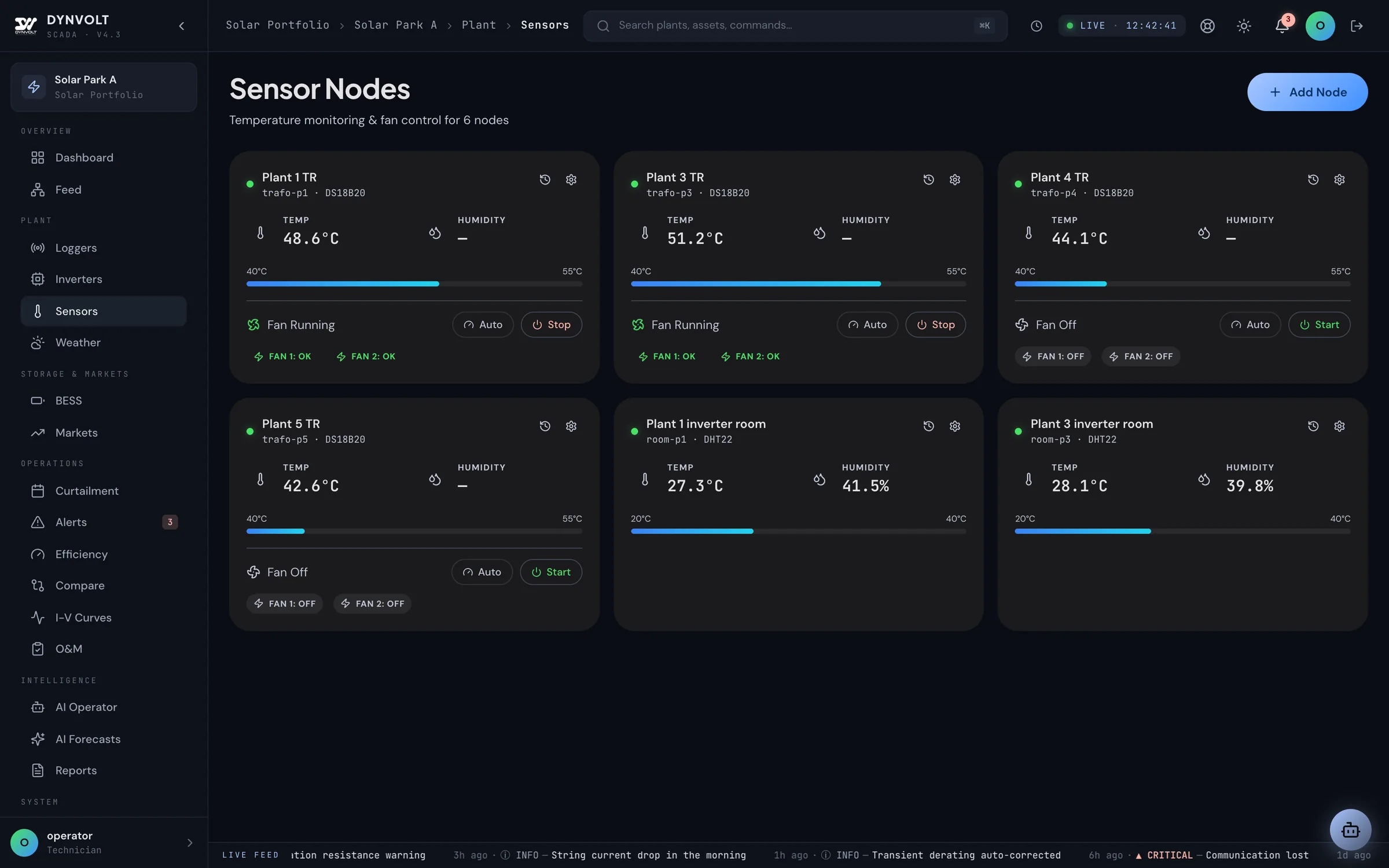
DYNVOLT owner console sensors page: transformer station temperature, fan relays and fan current from MQTT sensor nodes

Sensor nodes on MQTT.

Signals no inverter reports, such as transformer station temperature and whether the cooling fans actually draw current, come from our own sensor nodes over MQTT. They land in the same time series as the inverter data.

Two engineering days, last time we did it.

Any device exposing a documented Modbus TCP map can be added. Our most recent variant, including its weather-station and addressing quirks, took two engineering days. We will scope yours before you commit.

Send us the map

The device's Modbus register documentation, or access to one unit we can interrogate.

We scope it

A written effort estimate for your exact hardware, including quirks, before any commitment.

Validated on site

The integration ships once it reads correct values from your device on site. A register map that compiles is not enough.

IEC 60870-5-104, built to your operator's specification.

Direct telecontrol interfacing to a transmission or distribution system operator is delivered as a project build within the DYNVOLT platform rather than a shipped module. Every operator has its own point list and telecontrol specification, so we implement to yours, over the secure channel your operator specifies, with scope, timeline and acceptance testing agreed before the engagement starts. We are building one today for a distribution operator's remote-control requirement in North Macedonia.

The export limit configured at the point of connection is enforced from the edge on every site, and curtailment instructions from your operator are applied there.

Huawei, SmartLogger and SUN2000 are trademarks of their respective owners. Naming them here describes tested compatibility, not partnership or endorsement.

FAQ

Integrations: frequently asked

Can't find what you're looking for? Talk to our team →

How long does an integration take?
For a device with a documented Modbus TCP map, our most recent variant took two engineering days, including its weather-station and addressing quirks. We scope your exact hardware in writing before you commit.
Do I need to install firmware on inverters?
No. We read the manufacturer Modbus map natively. Where a BESS vendor requires an OEM control license for write access, that is between you and the OEM. We tell you upfront if your hardware needs one.
Can DYNVOLT push data to my data lake?
Telemetry, alerts and work orders are available over the REST API in JSON, and reports as CSV. If you need a specific warehouse pipeline, we scope it as integration work rather than promising a connector list.
Is there an API?
Yes. The public API covers telemetry, alerts, work orders and reports, with read and safe-write scopes per token; plant control is not exposed. It is rate-limited per token and every request is logged. The reference is at developers.dynvolt.com.

Send us your register map.

We'll scope the integration for your exact hardware, with effort, quirks, and timeline in writing, before you commit to anything.

Request an integration scopeSee the architecture →