PLATFORM / 01 / SCADA

String-level visibility, zero blind spots.

DYNVOLT SCADA polls every inverter, every string, every meter — every 30 seconds — over Modbus TCP. Detect underperformance, ground faults, and degradation before they cost you yield.

30s
Telemetry interval
14
Protocols supported
99.97%
Edge node uptime
< 50ms
Modbus poll latency
REAL-TIME TELEMETRY

Every inverter. Every string. Every 30 seconds.

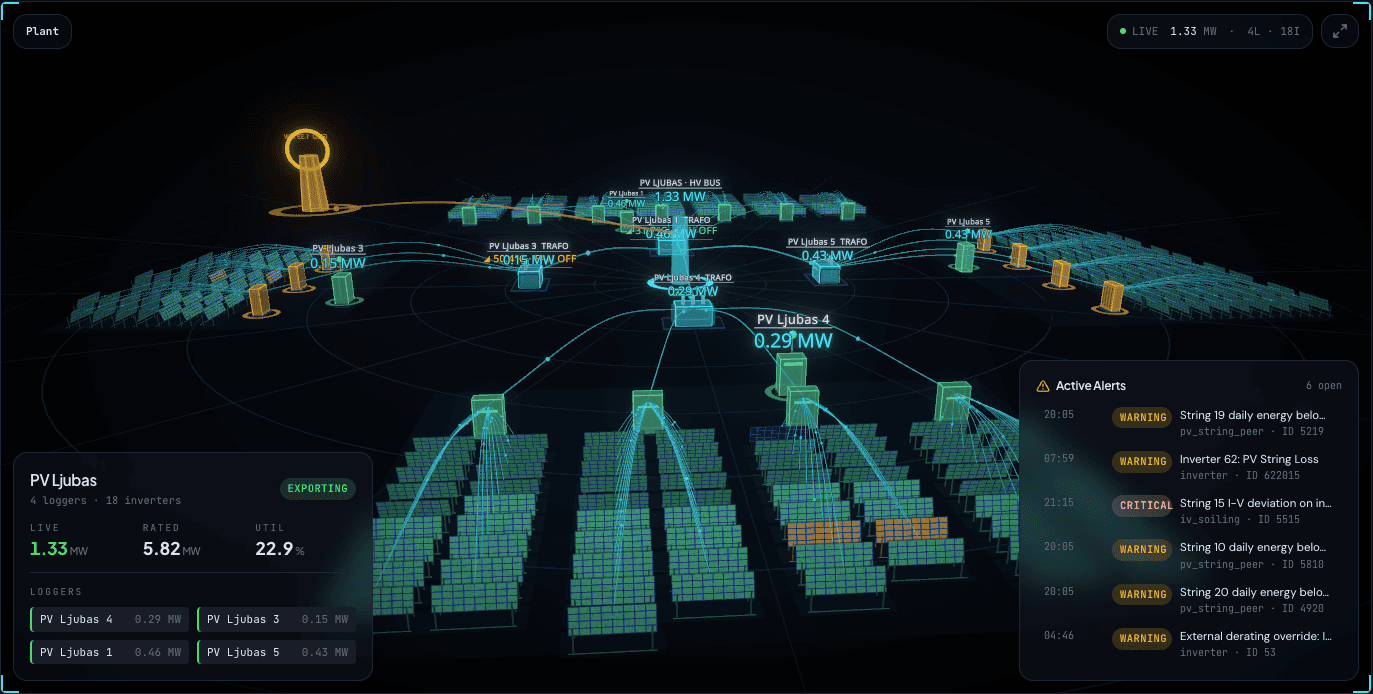
DYNVOLT speaks Modbus TCP natively. Edge node polls every device on a deterministic schedule, normalizes the readings into a single time-series schema, and pushes to your control room and the cloud simultaneously.
  • Per-string DC current and voltage — spot a degraded panel before it pulls down a whole combiner.
  • Per-inverter AC power, frequency, PF — match grid-operator requirements for reactive support.
  • Weather and irradiance — POA, GTI, ambient T, cell T, wind speed at 30s.
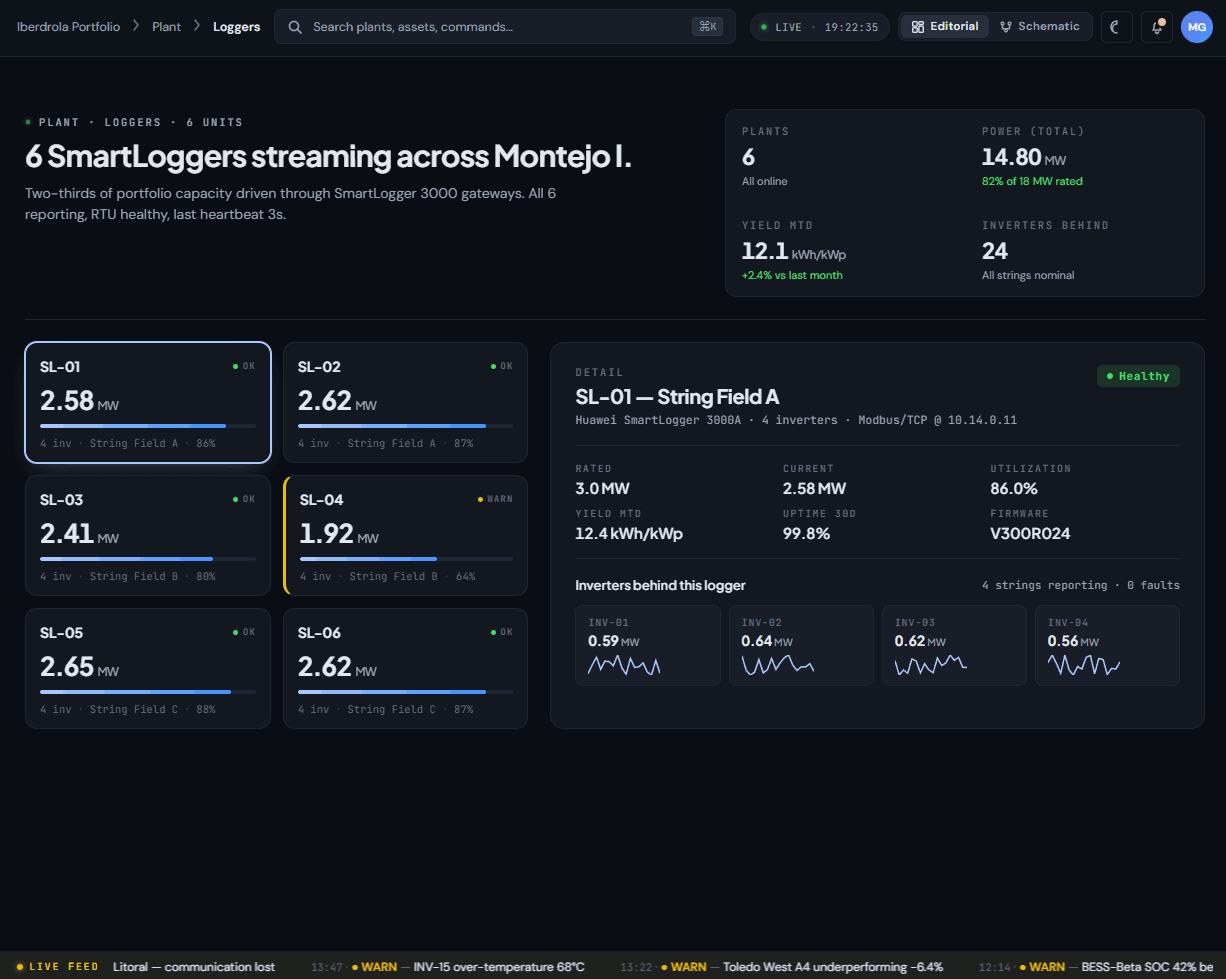
scada · live · INV-A1
DYNVOLT SCADA — string-level inverter monitoring with 30-second telemetry
CAPABILITIES

A SCADA built for utility-scale solar.

Hot-swap inverters without losing context.

Replacing an inverter? DYNVOLT continues the asset's history under the same logical ID. No data gaps, no lost trends.

Set-point write-back.

Push power limits and curtailment commands to inverters in response to grid-operator instructions or market dispatch.

F

Fault detection in < 30s.

Pattern-match string current vs. siblings to flag PID, soiling, and bypass-diode failures.

!

Severity-scored alerts.

Critical / High / Medium / Low classified automatically. Routed to your O&M ticket system.

Logical site mapping.

Group strings into combiners, combiners into trackers, trackers into blocks. Aggregate any way.

IV

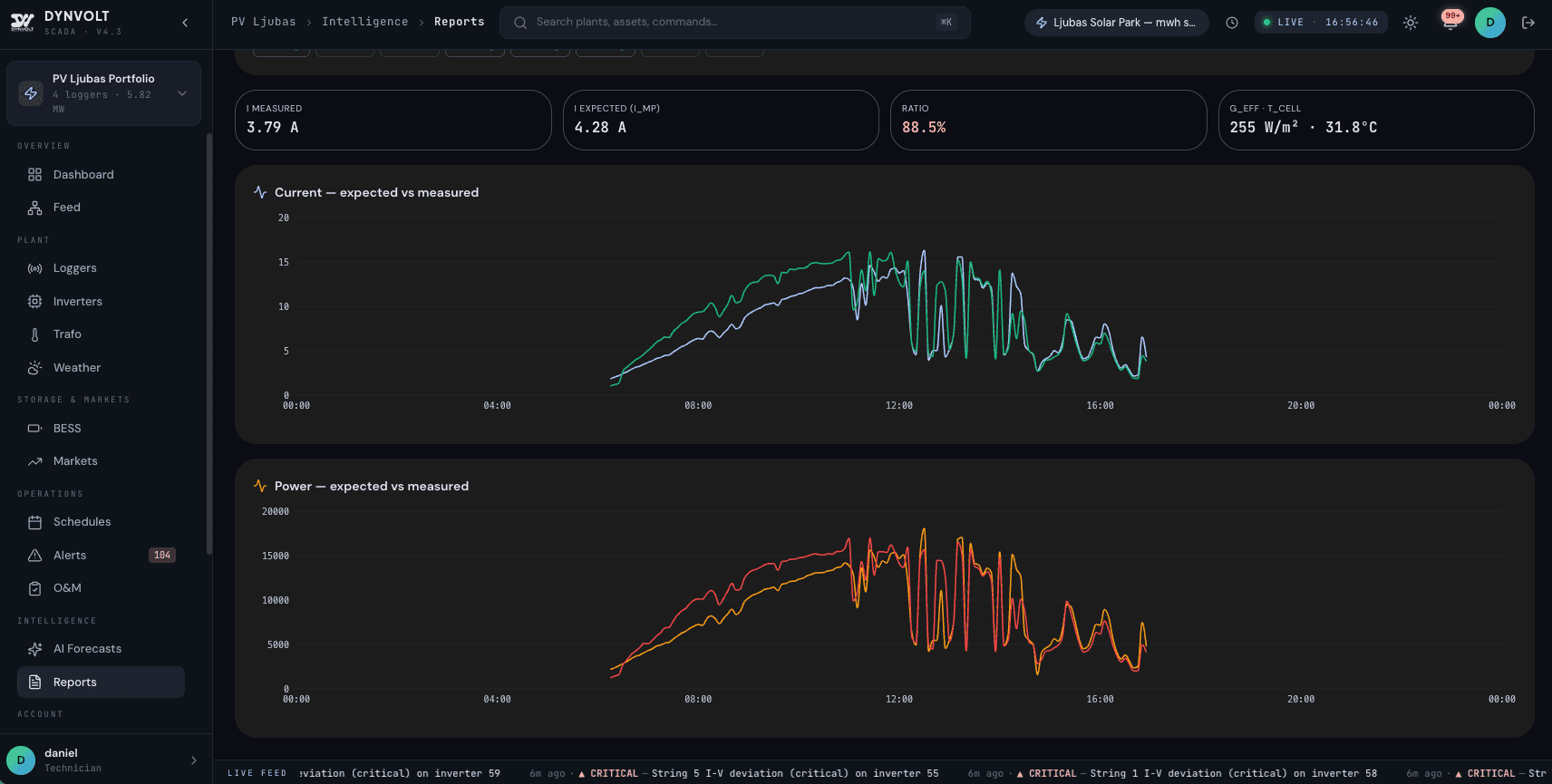
I-V curve tracking, every 30 seconds.

Every string's measured current is continuously benchmarked against the model-expected curve under live irradiance and cell temperature. Ratios below threshold flag PID, soiling, bypass-diode failures, and degradation — long before they show up in a monthly performance report.

DYNVOLT — I-V curve monitoring: per-string measured vs expected current and power, with live deviation alerts

Pair SCADA with AI Forecasting.

DYNVOLT's forecasting models train directly on your SCADA history — no data prep, no integrations.
Read about Forecasting →Request a demo
FAQ

SCADA — frequently asked

Can't find what you're looking for? Talk to our team →

How fast does DYNVOLT poll inverters?
Edge nodes poll over Modbus TCP every 30 seconds by default; we can tune to 10s for high-frequency control. Latency to the cabinet stays under 50ms.
Which inverter brands are supported?
Huawei, Sungrow, SMA, Solis, Sineng, GoodWe, Solplanet, KSTAR, Ingeteam, Power Electronics, plus generic Modbus TCP and Sunspec maps for everything else.
Does it work without internet?
Yes. The edge node has a 14-day local buffer and runs control logic, alarms, and interlocks autonomously. When the link returns, history is replayed gap-free.
Can it write set-points back to inverters?
Yes — power limits, curtailment, reactive support, and grid-code dispatch are pushed back via the same Modbus session. Write-back is gated by RBAC and audit-logged.
What about string-level visibility?
Per-string DC current, voltage, and energy are normalized into the same time-series schema as plant aggregates. Sibling-comparison logic flags PID, soiling, and bypass-diode failure within 30 seconds.