ENERGY MANAGEMENT SYSTEM

The energy management system layer your SCADA is missing.

Forecasting, dispatch, curtailment and market bidding on top of plant control. One edge-first stack, per-MW pricing.

97.8%
Peak forecast accuracy
8
European power markets
30s
Telemetry over Modbus TCP
2–4 wks
From hardware to live
ALSO KNOWN ASSolar EMS·Renewable EMS·Hybrid plant EMS·Microgrid EMS·EMS software
WHAT IS AN ENERGY MANAGEMENT SYSTEM?

SCADA, EMS and PPC do three different jobs.

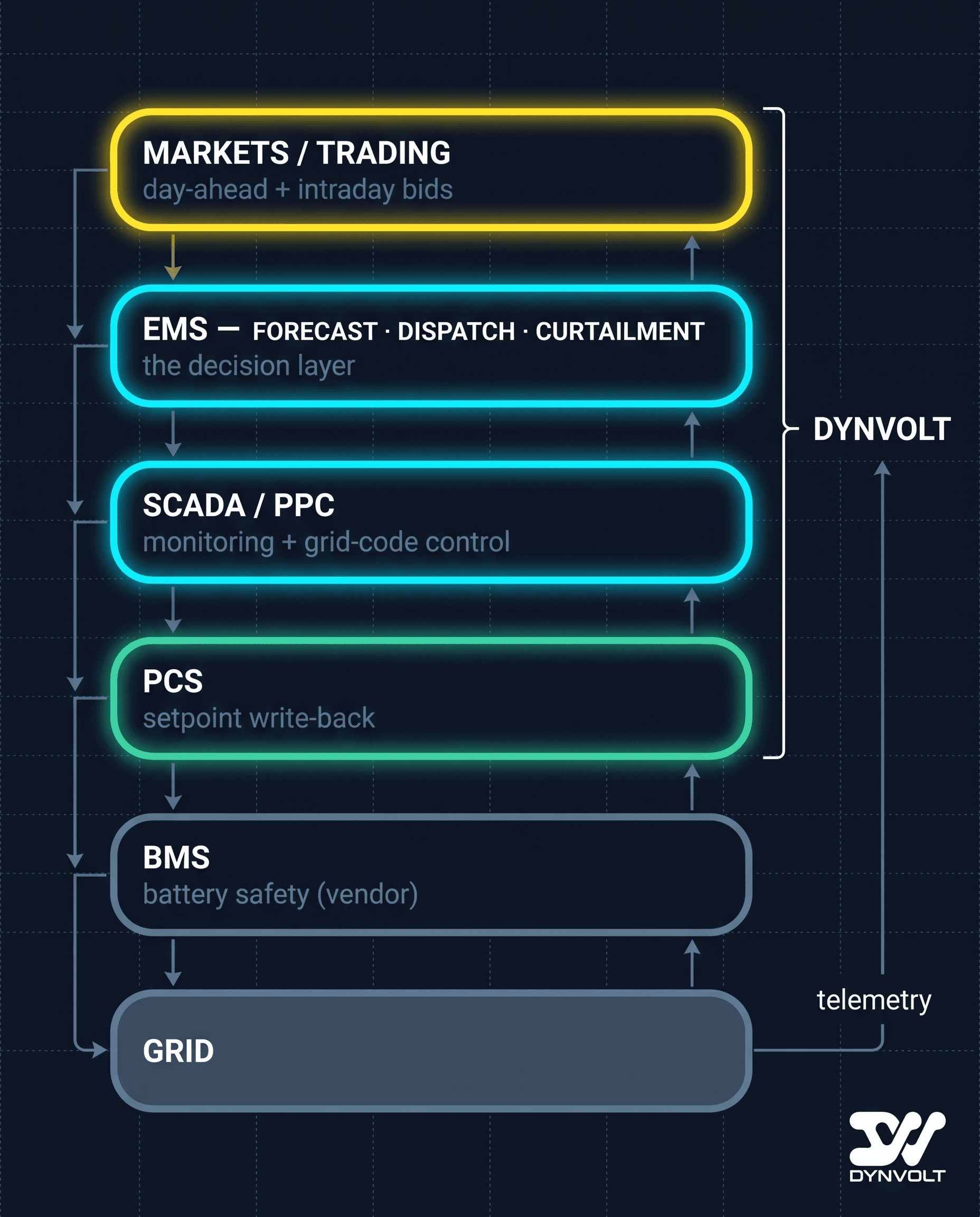
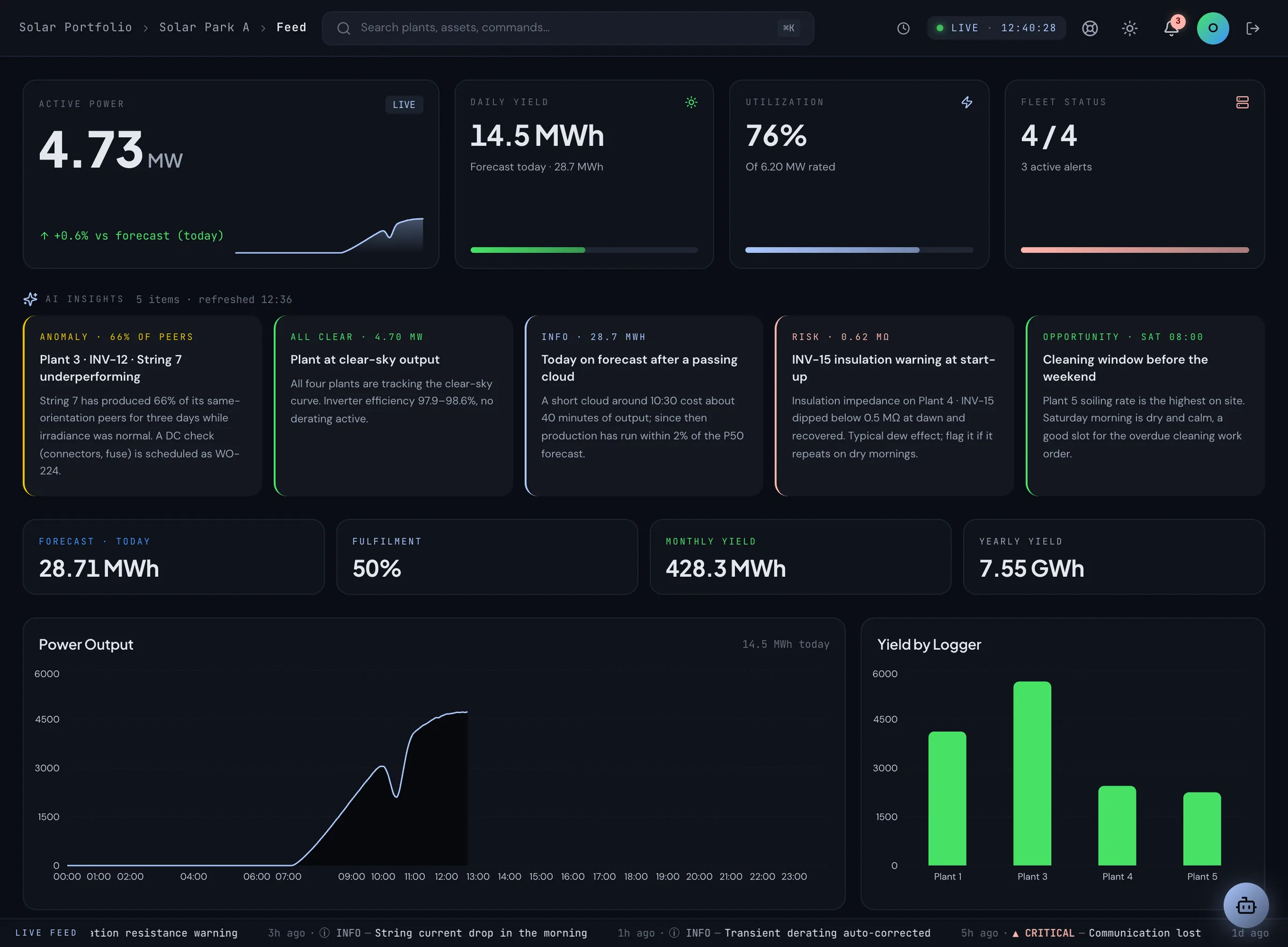
A renewable plant runs on three software layers, and the terms get used interchangeably — wrongly. SCADA is the visibility and control layer: it polls every inverter, meter and tracker, surfaces string-level telemetry, raises alarms, and writes setpoints back to devices. It tells you what the plant is doing and lets you command it. A power plant controller (PPC) is the grid-code layer: it regulates active and reactive power at the point of interconnection — voltage, frequency and ramp-rate compliance enforced in milliseconds to satisfy the TSO. An energy management system (EMS) is the decision layer that sits above both. It answers the question neither SCADA nor the PPC can: what should this plant do to be worth the most? The EMS ingests price forecasts and production forecasts, builds a day-ahead bid, rebids intraday, schedules curtailment when prices go negative, and co-optimizes any co-located battery. SCADA executes, the PPC keeps you compliant, and the EMS decides. DYNVOLT is the EMS — and it runs on top of the SCADA and PPC you already have, integrating at the protocol level rather than replacing them.

CapabilitySCADAPPCDYNVOLT EMS
String-level monitoring & alarms
Setpoint write-back to devices
Grid-code regulation at the POIpartialintegrates
Production forecasting (P10–P90)
Day-ahead & intraday market bidding
Price-aware curtailment
Battery dispatch co-optimization
Decision audit trail

Already running SCADA? See how DYNVOLT layers on top →
THE EMS LOOP

Forecast, bid, rebid, curtail — every day, automatically.

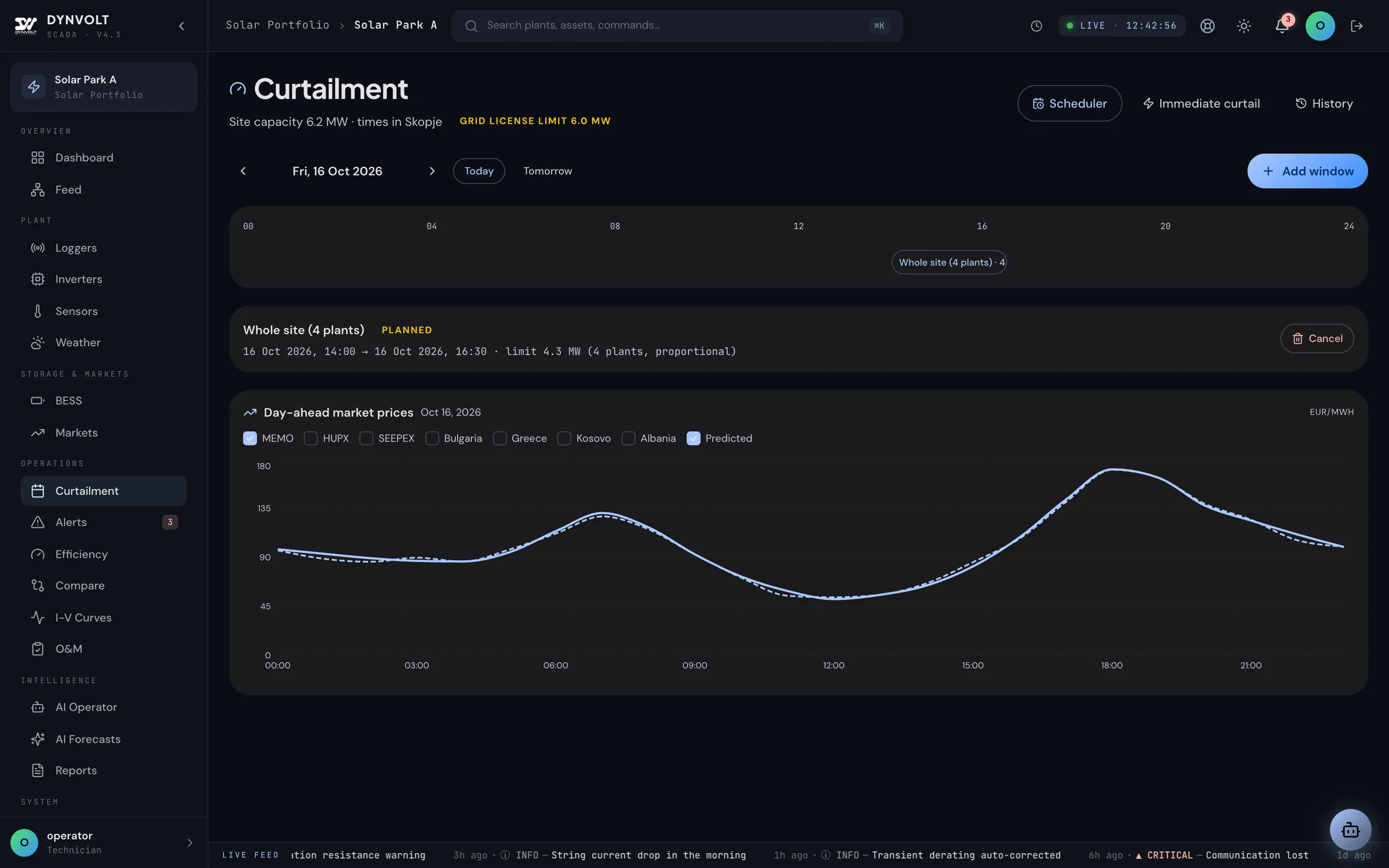
The EMS runs a closed loop from weather to power exchange. Each stage feeds the next, and every decision is logged with the forecast and price that drove it.

01
Forecast

An ensemble of ECMWF, GFS and ICON produces a P10–P90 production curve for the next delivery window, retrained weekly on your own SCADA data.

02
Day-ahead bid

The optimizer turns the P50 forecast into price-quantity pairs across all 24 hours, with P10/P90 risk premiums baked in, formatted for your BRP to submit before gate closure.

03
Intraday rebid

As the forecast firms up, the EMS captures price moves between gate closure and delivery — rebidding continuously instead of holding a stale day-ahead position.

04
Real-time curtailment

When prices go negative or the TSO signals a constraint, the EMS curtails at the edge and recovers the energy into any co-located battery — no manual intervention.

BUILT FOR INTEGRATION

Technology-neutral by design.

DYNVOLT integrates at the protocol level, not the vendor level. It speaks to the equipment you already run, and the same decision engine extends from solar to storage to hybrid microgrids.

Protocol-level integration

Modbus TCP and SunSpec on every inverter, with OPC-UA, IEC 61850 and DNP3 for storage and substation gear. 24 integrations across the major inverter and BESS families — no firmware to flash.

Solar today

Live across utility-scale PV with string-level visibility and 30-second telemetry. The forecasting, bidding and curtailment loop is proven on solar in production.

Architected for hybrid

The dispatch model already co-optimizes PV with co-located storage. Adding a battery is a configuration, not a re-platform.

Storage-ready

Writes active and reactive setpoints to the PCS and enforces the warranty envelope — the battery EMS is the same engine, not a bolt-on.

Microgrid path

The edge-first stack runs on-site and keeps deciding when the link drops, which is exactly what an islanded microgrid EMS needs.

INSIDE THE EMS

Four modules, one decision engine.

The EMS is not a separate product — it is what happens when forecasting, market access, battery dispatch and plant control share one stack. Each module links out to its own deep dive.

WHERE IT RUNS TODAY

Honest about capability versus reference.

DYNVOLT is live on utility-scale solar plants across eight central and south-east European markets — production deployments in North Macedonia, Serbia, Bulgaria, Romania, Croatia, Greece and Hungary. The forecasting, bidding and curtailment loop is proven there today. Hybrid, standalone-storage and microgrid EMS are capabilities the platform is architected for — the dispatch engine, protocol stack and edge runtime already support them — but we will tell you plainly which parts are running in production at a reference site and which would be a first for your asset class. No vaporware, no reference-washing.

PRICING

Per-MW pricing. No per-user fees.

The EMS is priced per MW of installed capacity — Operate scales with solar MW, the AI Module with AI-enabled MW. One flat setup fee per site covers survey, edge hardware and SCADA integration.

Operate

Per solar MW. SCADA, monitoring, alarms, set-point write-back and price-aware curtailment.

AI Module

Per AI-enabled MW. Forecasting, dispatch and market bidding — the EMS decision layer.

See full pricing → · Explore the modules: SCADA, AI forecasting, energy markets, BESS optimization.

Put a decision layer on top of your plant.

Request a demoSee pricing →
FAQ

Energy management system — frequently asked

Can't find what you're looking for? Talk to our team →

What is an energy management system (EMS)?
An EMS is the decision layer that sits on top of plant control. For a renewable plant it ingests price forecasts and production forecasts, builds the day-ahead bid, rebids intraday, schedules curtailment when prices go negative, and co-optimizes any co-located battery. SCADA executes and the power plant controller keeps you grid-compliant; the EMS decides what the plant should do to be worth the most.
What is the difference between an EMS and SCADA?
SCADA is the visibility and control layer — it polls every device over Modbus TCP, surfaces string-level telemetry, raises alarms, and writes setpoints back. An EMS is the decision layer above it: forecasting, market bidding, curtailment and battery dispatch. SCADA tells you what the plant is doing; the EMS decides what it should do. DYNVOLT runs on top of your existing SCADA rather than replacing it.
What is the difference between an EMS and a PPC?
A power plant controller (PPC) regulates active and reactive power at the point of interconnection to satisfy grid code — voltage, frequency and ramp-rate, enforced in milliseconds. An EMS works on a longer horizon and an economic objective: which bid to place, when to curtail, how to dispatch storage. The PPC keeps you compliant; the EMS makes the plant profitable. DYNVOLT integrates with your PPC, it does not replace it.
Do I need an EMS for a solar plant?
If you only need to see and control the plant, SCADA is enough. You need an EMS once you want the plant to participate in markets — day-ahead and intraday bidding, price-aware curtailment, or battery co-optimization. DYNVOLT layers all of that on top of your existing control stack and is typically live in 2–4 weeks.
Does DYNVOLT work as a renewable or hybrid plant EMS?
Yes. The EMS is live on utility-scale solar across 8 European markets today, with up to 97.8% forecast accuracy and P10–P90 production bands. The same dispatch engine already co-optimizes PV with co-located storage, so adding a battery is a configuration rather than a re-platform. Standalone-storage and microgrid EMS use the same edge-first stack.
Does the EMS replace my inverters' or battery's existing systems?
No. DYNVOLT integrates at the protocol level — Modbus TCP and SunSpec on inverters, OPC-UA and IEC 61850 on storage and substation gear — across 24 integrations. It writes setpoints but never overrides the BMS safety layer or the PPC grid-code layer. It is a decision layer on top of the equipment you already run.
Is the EMS edge-first or cloud-based?
Both. The decision engine runs on an embedded edge node on-site with 30-second telemetry and a local buffer, so the plant keeps forecasting, curtailing and dispatching even when the internet drops. Results sync to the cloud when the link returns. That offline resilience is what an islanded microgrid EMS needs.
How is the EMS priced?
Per MW of installed capacity — Operate scales with solar MW, the AI Module (the EMS decision layer) scales with AI-enabled MW. There are no per-user or per-data fees, plus one flat setup fee per site covering survey, edge hardware and SCADA integration. We quote inside 48 hours after a short call.