"Energy management system" is one of the most overloaded acronyms in the power industry. Ask five vendors what their EMS does and you will get five different products: a building-automation controller that trims HVAC peaks, a microgrid controller that islands a campus, a battery dispatch optimizer, a utility-grade SCADA suite with a dashboard bolted on, and a trading platform that bids your output into the day-ahead market. They all answer to "EMS," and they are not substitutes for each other.
For the owner or asset manager of a utility-scale solar or hybrid plant, that ambiguity is expensive. You can run a six-month procurement, sign a multi-year contract, and discover that the "EMS" you bought monitors beautifully but cannot place a bid, or trades well but cannot see a string-level fault, or does both in a slide deck and neither in production. The category is too important — and too poorly defined — to evaluate on a feature checklist a vendor wrote about itself.
This is a buyer's guide, not a ranking. We are not going to tell you which logo to pick; the right answer depends on your assets, your market, and whether you have a trading desk. What we will give you is the set of questions that actually separate an EMS that earns its keep from one that becomes shelfware — and a scoring rubric you can take into any vendor call.
- "EMS" is not one product category — building EMS, microgrid EMS, BESS EMS, and renewable-trading EMS solve different problems. Match the tool to your asset and revenue model before comparing features.
- The single most predictive question is native scope: how many of forecast → bid → curtail → dispatch the platform does itself, versus stitching together other vendors' tools at integration seams that cost data, latency, and revenue.
- An EMS should layer on top of your existing SCADA and power plant controller at the protocol level, not force a rip-and-replace — and it must never override the BMS safety layer or grid-code compliance.
- Edge-first beats cloud-only for anything that touches control: if the decision loop dies when the internet does, it is a dashboard, not an energy management system.
- Score vendors on data ownership, pricing transparency, and deployment time alongside features — these structural terms cost more over the contract life than any single capability.
First, Figure Out Which "EMS" You Need
Before you compare vendors, classify the problem. The four families that all call themselves EMS:
- Building / facility EMS — optimizes HVAC, lighting, and demand charges in a commercial or industrial building. Wrong tool for a generation asset; ignore for utility-scale solar.
- Microgrid EMS — coordinates generation, storage, and load on an islandable network, often with diesel or grid backup. Relevant if you run a campus, island, or off-grid site; overkill for a grid-tied PV plant.
- BESS EMS — the dispatch brain for a battery: arbitrage, ancillary services, imbalance, cycle-cost management. Essential if storage is your primary asset.
- Renewable / generation EMS — the decision layer for a grid-tied solar, wind, or hybrid plant: production forecasting, day-ahead and intraday bidding, price-aware curtailment, and storage co-optimization on top of plant control.
A utility-scale solar or hybrid operator almost always needs the last one — and frequently needs it to contain the BESS-EMS function rather than buying that separately. If a vendor cannot tell you which family they are in without a fifteen-minute preamble, that is itself a data point.
The Eight Criteria That Matter
Once you are comparing like with like, these are the axes that predict whether the platform earns back its cost. Score each 1–5.
1. Native scope vs bolted-on
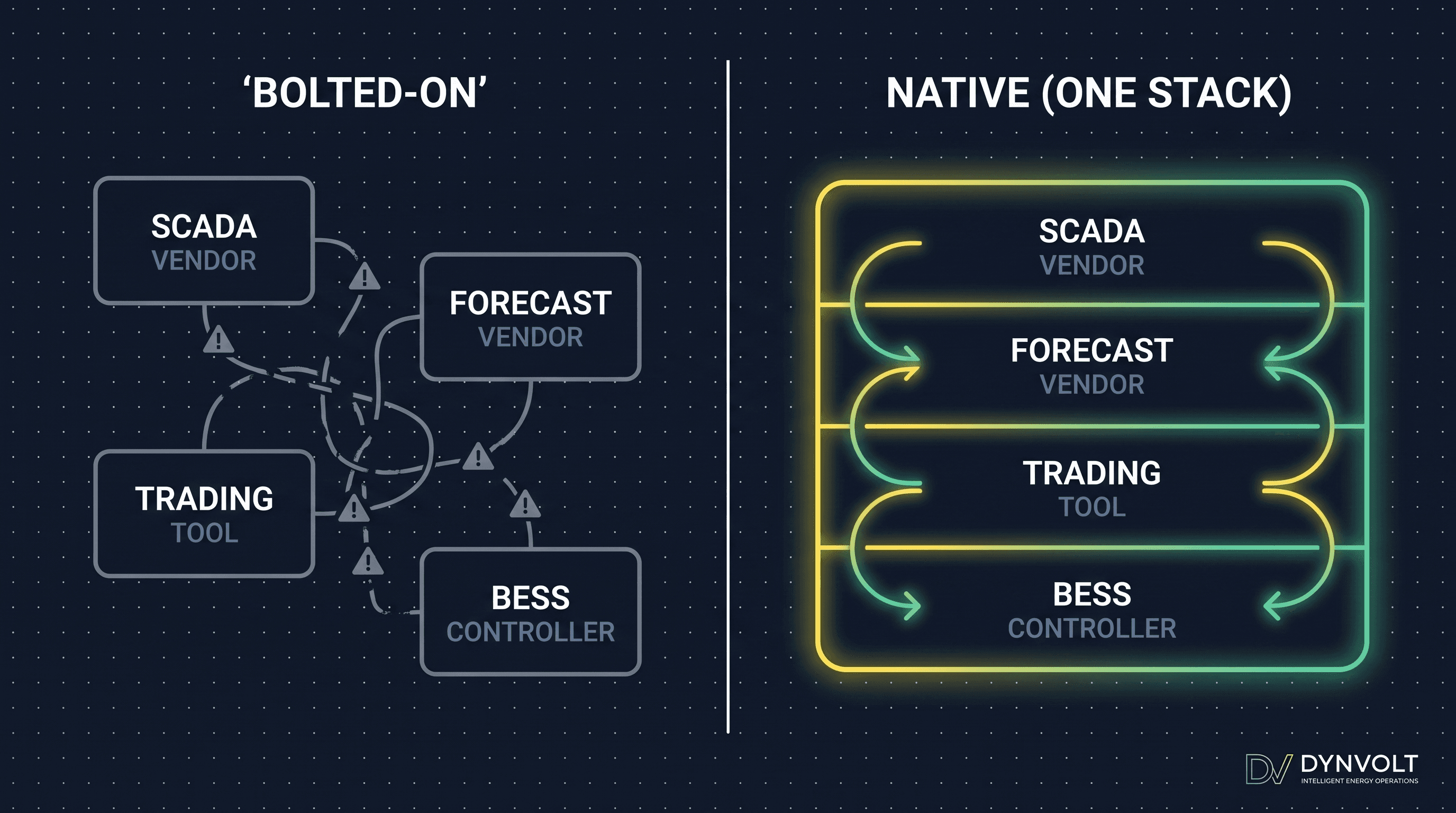
The highest-leverage question in the entire evaluation: of forecast → day-ahead bid → intraday rebid → real-time curtailment → battery dispatch, how many does the platform do itself? Every capability a vendor delivers by integrating someone else's tool introduces a seam — and seams cost data fidelity, latency, and revenue. A forecast handed across an API to a separate trading tool arrives later and lossier than one produced inside the same engine that builds the bid.
Be specific. Ask which functions are native code and which are partnerships or resold modules. A platform that natively owns four of the five will out-execute a "best-of-breed" assembly of five vendors, because the four are co-optimized against one another instead of negotiating across contracts.
2. SCADA and PPC integration
A good EMS is a decision layer that sits on top of the control you already have. It should integrate with your existing SCADA and power plant controller at the protocol level — Modbus TCP, SunSpec, OPC-UA, IEC 61850 — not demand a rip-and-replace of working hardware. Ask explicitly: does this replace my SCADA, or layer on it? Does it write setpoints through the PPC and respect grid-code limits, or around it?
The disqualifier: any EMS that needs to sit inside the safety loop, or that cannot articulate how it stays clear of the BMS and the PPC's grid-code authority. The EMS decides economics; it must never be the thing standing between the plant and a safe shutdown. (For the full SCADA vs EMS vs PPC distinction, see our EMS overview.)
3. Forecasting quality
Production forecasting is the input to every downstream decision, so forecast quality multiplies through the whole stack. Probe past the headline accuracy number:
- Does it produce probabilistic forecasts — P10/P50/P90 bands — or a single point estimate? A point forecast is most confidently wrong exactly when it costs the most, on partly-cloudy days.
- Is it retrained on your plant's own data, or a generic regional model? The plant's signature drifts; the model must track it.
- What weather inputs — single source or an ensemble (ECMWF, GFS, ICON)?
A vendor who quotes one accuracy figure and cannot show you the distribution behind it is selling you the demo, not the system.
4. Market and dispatch capability
If the point of the EMS is revenue, this is where it is earned. Ask which markets it supports natively, whether it constructs day-ahead and intraday bids as submission-ready price-quantity pairs, and how it handles imbalance — the charge that quietly eats solar margins every hour the forecast misses. A platform that "supports trading" by exporting a CSV you hand to a desk is doing a fraction of the job of one that builds BRP-ready schedules and rebids intraday as the forecast firms.
5. Edge-first vs cloud-only resilience
The test: what happens to the decision loop when the internet drops? Rural plants have rural connectivity. If forecasting, curtailment, and dispatch run only in a datacenter, an outage is a data gap and a missed trade at best, and a control blind spot at worst. An edge-first EMS runs the time-critical logic on-site with a local buffer and syncs to the cloud when the link returns. Cloud-only is fine for fleet reporting; it is disqualifying for anything in the control path.
6. Battery and hybrid co-optimization
If you have storage now — or might add it — the EMS should dispatch the battery against the solar plant, not in isolation: clipping recovery, curtailment soak, evening-peak discharge, and ancillary services solved in one model that respects state-of-charge, cycle budget, and the warranty envelope. Two separate optimizers (one for PV, one for the battery) will fight each other at the seam. Ask whether hybrid co-optimization is native or a roadmap promise — and make them show it, not say it.
7. Data ownership and exit terms
The unglamorous criterion that costs the most over a contract's life. Who owns the time-series data — you or the vendor? Can you export it in full, in a standard format, on demand? What are the exit terms, and is there source escrow if the vendor disappears? An EMS accumulates years of your plant's operating history; if that history is hostage to the platform, every renewal negotiation starts from a weak position.
8. Pricing transparency and deployment time
"Contact us for pricing" is a yellow flag; published per-MW pricing tells you the vendor expects to compete on value, not on opacity. Ask for the all-in number — software, edge hardware, integration, support — and the realistic time from contract to live. Enterprise EMS rollouts are measured in quarters; a modern edge-first platform on hardware you already have should be measured in weeks. A long deployment is not a sign of sophistication; it is a cost and a risk.
A Scoring Rubric You Can Use
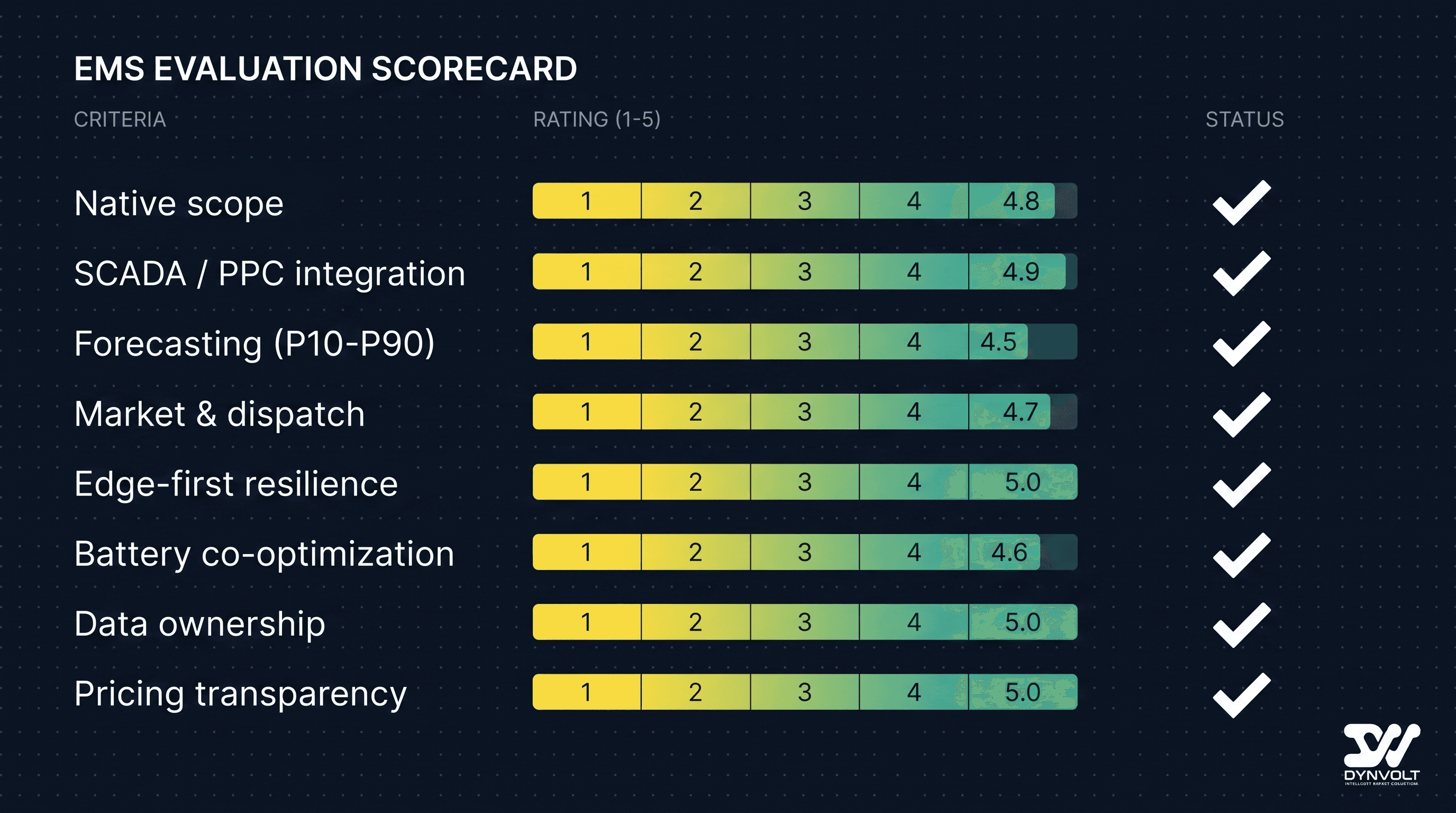
Take the eight criteria into every vendor call and score 1–5:
- Native scope — fraction of forecast→bid→curtail→dispatch owned in-house.
- SCADA / PPC integration — protocol-level, layers on, respects safety.
- Forecasting — probabilistic, retrained on your data, ensemble inputs.
- Market & dispatch — native markets, day-ahead + intraday, imbalance handling.
- Edge-first resilience — decision loop survives an outage.
- Battery co-optimization — one model across PV and storage.
- Data ownership — you own and can export; clean exit terms.
- Pricing & deployment — transparent pricing, weeks not quarters.
Weight them to your situation — a merchant plant in a volatile market weights 1, 3, and 4 heaviest; an off-grid hybrid weights 5 and 6. A vendor who scores 5 on a glossy dashboard but 2 on native scope and edge resilience is selling you a screen, not an energy management system.
Red Flags
- "We do everything" — with no clear answer on which functions are native versus integrated. Everything-via-partners is the integration tax in disguise.
- Reference-washing — "capable of" hybrid/microgrid/wind with no production reference. Ask plainly what runs at a real site today versus what would be a first.
- Cloud-only control — the decision loop depends on connectivity.
- Opaque pricing and long lock-ins — the structural terms that outlast every feature.
- Replaces your SCADA/PPC — a decision layer should not demand you tear out working, safety-critical control.
Where DYNVOLT Fits
We build the renewable/generation EMS in that taxonomy: day-ahead forecasting with published error, bid construction (you remain the market participant — we never submit), and price-aware curtailment, natively in one edge-first stack that layers on top of your existing SCADA and PPC at the protocol level — Modbus TCP and MQTT in production today, with more protocols on the build path. We publish per-MW pricing, and our documented onboarding is 2 days from gateway to live telemetry and 7 days to the full module set on hardware you already have. We are also candid about scope — solar is proven in production today across our North Macedonia fleet (two plants, 15.84 MW AC); PV+BESS co-optimisation is modelled, and intraday, standalone-storage and microgrid are in active development, with measured results published before we sell into each.
That is our answer to the rubric above — but the rubric is the point. Score every vendor on the same eight axes, weight them to your plant, and the right choice for your assets will separate from the noise. See how our EMS maps to these criteria →