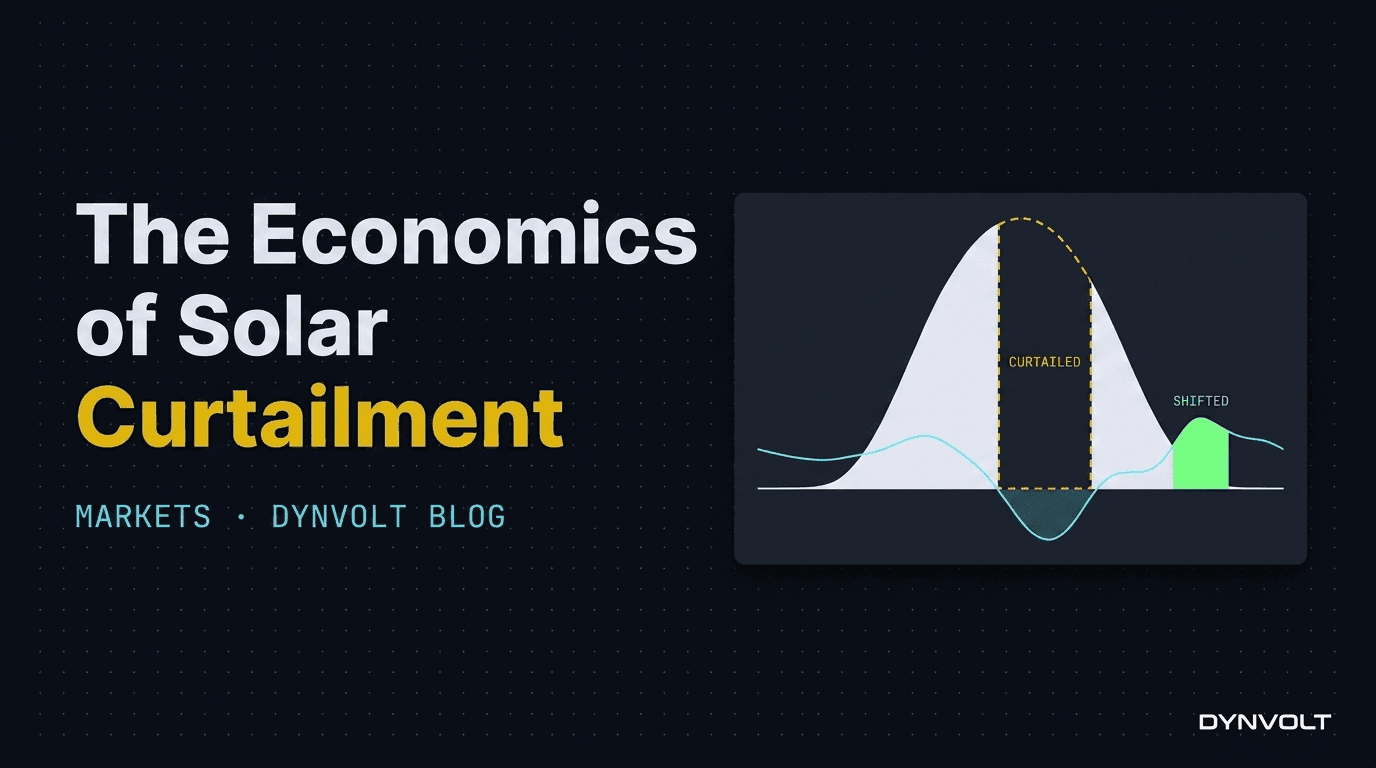
Every utility-scale solar plant is built on a forecast of how many megawatt-hours it will sell. Curtailment is the gap between the megawatt-hours the plant could have produced and the ones it was allowed to. It is the most under-modelled line item in a solar P&L — financiers stress-test irradiance, degradation, and availability to three decimal places, then wave through a flat low-single-digit curtailment assumption that the asset blows past in its second summer. In several European bidding zones, curtailment and negative-price hours have gone from a rounding error to a material share of the merchant revenue stack in several zones over recent years.
The reflex is to treat curtailment as pure loss — energy spilled, revenue gone, nothing to do. That reflex is wrong on two counts. First, not all curtailment is the same: some of it is forced on you by the grid for free, some of it is a price signal you are choosing to respond to, and the two have completely different economics. Second, a plant with the right downstream — a battery, a flexible PPA, a smart dispatch layer — does not spill curtailed energy at all. It moves it. The MWh that the market did not want at 13:00 is the same MWh the market pays a premium for at 19:00.
This article is about the money. Where curtailment comes from, why it is accelerating, the difference between the kind that costs you and the kind that pays you, and the concrete levers — storage, dispatch, contract structure — that turn curtailed energy from a write-off into a revenue stream. We close with a worked, explicitly illustrative example from the MEMO zone and a checklist for modelling curtailment honestly before you sign the financing.
- Curtailment is not one thing — network/forced curtailment (grid can't take the power) and economic curtailment (price has gone negative) have opposite economics and demand opposite responses.
- Negative and near-zero prices are the fast-growing driver: as solar penetration rises, midday clearing prices collapse and a rational operator curtails voluntarily rather than pay to export.
- Whether curtailment is compensated depends entirely on the regulatory regime and PPA structure — uncompensated network curtailment is a direct hit to merchant revenue that flat-rate financial models routinely understate.
- A co-located battery converts the highest-curtailment hours into the highest-value dispatch windows: soak the midday surplus, discharge into the evening peak, and the curtailed MWh is recovered at a price premium rather than lost.
- Curtailment must be modelled as an hourly, price-coupled time series — not a flat annual percentage — or the financing case is wrong in exactly the hours that matter most.
Where Curtailment Comes From
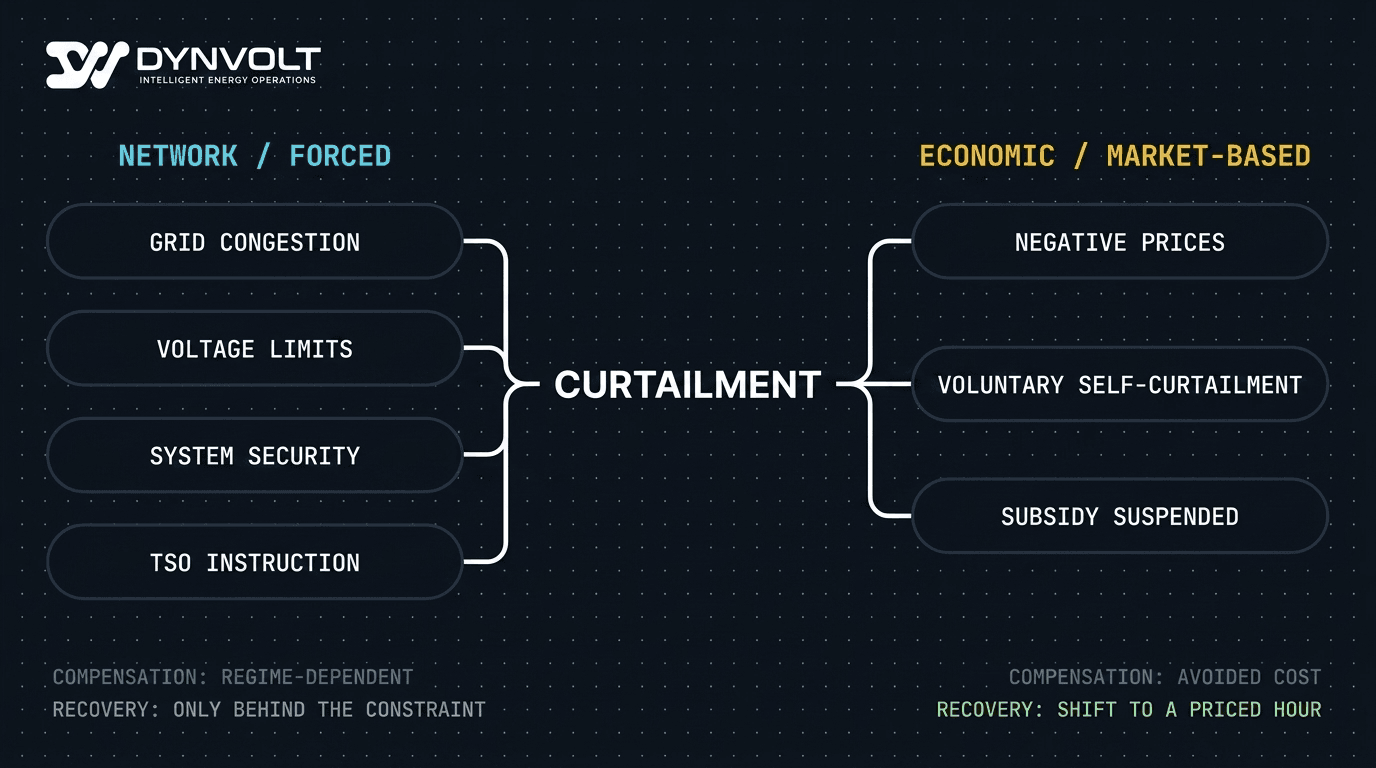
Curtailment is the deliberate reduction of a plant's output below what the available irradiance would support. It happens for two fundamentally different families of reasons, and the single most common modelling error is to lump them together.
Network and system curtailment is imposed by the grid operator. The plant is producing more than the local network can absorb or evacuate, and the TSO or DSO instructs it down to keep the system inside its limits. The triggers are physical:
- Transmission congestion. The line or transformer between the plant and the load centre is at thermal capacity. New solar clusters in rural, high-irradiance areas routinely outrun the grid that was built for a sparser, fossil-era topology.
- Local voltage and reactive-power limits. High midday injection on a weak feeder pushes voltage out of band; the operator curtails active power to bring it back.
- System security and minimum-generation constraints. The system needs a floor of synchronous, inertia-providing generation for stability; when inflexible must-run plant plus renewables exceeds demand, renewables are curtailed to keep the system balanceable.
- Planned and forced outages. A line out for maintenance shrinks the evacuation capacity and the plant behind it gets clipped.
Economic and market-based curtailment is a price response. Nobody instructs the plant down — the operator (or the BRP acting for it) chooses to stop exporting because exporting has become value-destroying:
- Negative or zero clearing prices. When the day-ahead or intraday price goes negative, every MWh exported costs money. A merchant plant with no production-linked subsidy is strictly better off curtailing than paying to generate.
- Subsidy design that flips at negative prices. Several support schemes suspend payments during sustained negative-price windows, removing the incentive to push through them.
- Self-curtailment to protect a hedge. A plant inside a PPA or balancing position may curtail to avoid imbalance exposure when its forecast and the realised price diverge.
The distinction matters because the response is different. You cannot store your way out of a hard thermal-line constraint that also caps your battery's export. You absolutely can store your way out of a negative-price midday — the battery removes energy from the oversupplied hour and returns it to a scarce one. Confusing the two leads to the two classic mistakes: sizing a battery against a constraint it cannot relieve, or writing off as "lost" energy that smart dispatch would have monetised.
Why It Is Accelerating
Curtailment used to be a localised, occasional event. It is becoming a structural feature of high-renewables markets, for reasons that compound:
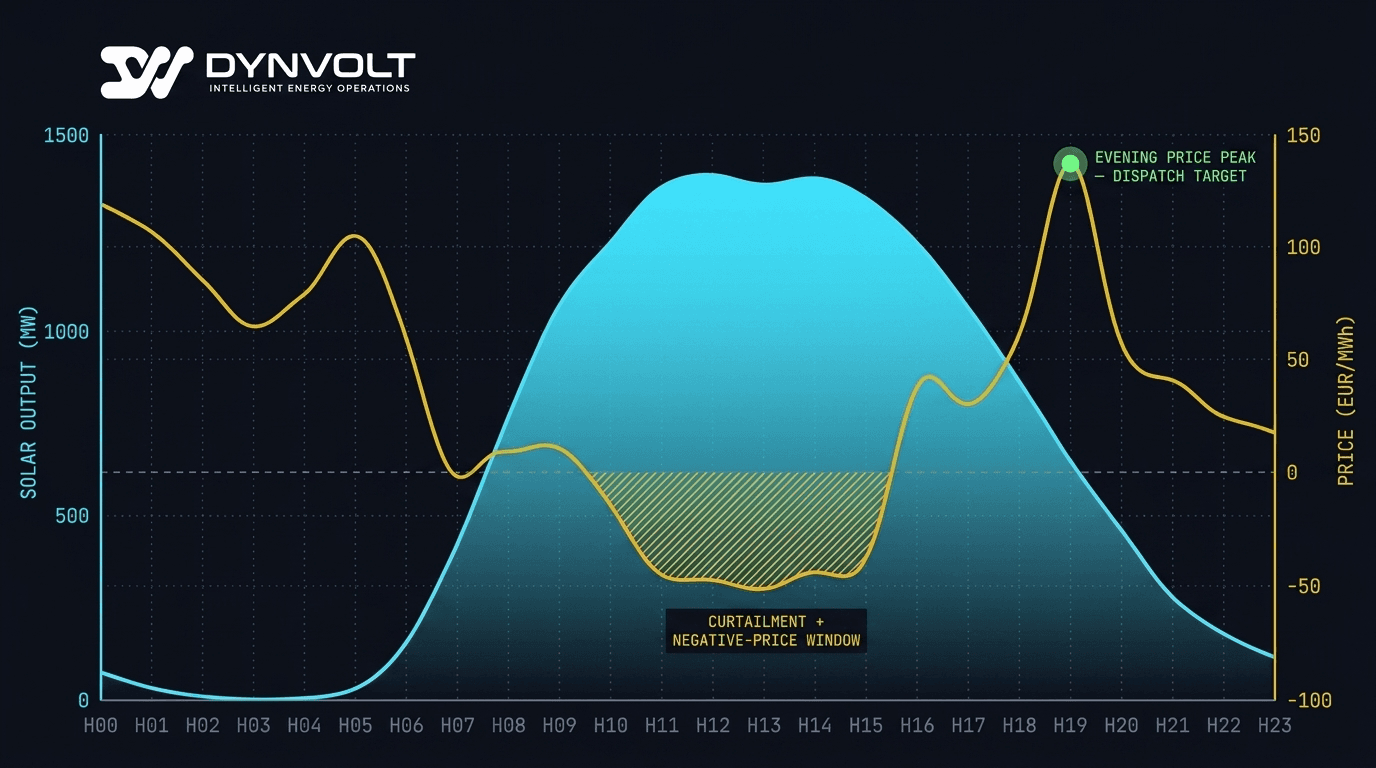
The midday duck-curve deepens with every gigawatt of solar added to a zone. Solar is correlated — every plant in a region produces at the same time — so the marginal plant arrives into a market that is already long on sunny middays. Clearing prices in the solar window fall toward, and then through, zero. The same hours that yield the most energy yield the least value, and eventually negative value.
Grid build-out lags generation build-out by years. Permitting and constructing a transmission line takes far longer than energising a solar farm, so network-congestion curtailment grows mechanically as connection queues fill faster than reinforcement projects complete.
Market coupling propagates the surplus. In coupled European day-ahead markets, a negative-price event in one large zone bleeds across interconnectors into neighbours — smaller and emerging markets like those in South-East Europe increasingly import the price signal of the bigger coupled pools. A plant in a previously "safe" zone inherits the negative-price hours of the system it is coupled to.
The net effect: the curtailment line in a solar model is not a flat percentage drifting slowly upward. It is a steepening function of penetration, concentrated in specific hours, and increasingly coupled to price rather than purely to local network state.
The Economics: Compensated vs Uncompensated
The financial impact of curtailment turns on one question: who pays for the spilled energy? There is no universal answer — it is set by the regulatory regime and the contract, and it varies by market and by curtailment type.
| Curtailment type | Typical compensation | Revenue impact | Can a battery recover it? |
|---|---|---|---|
| Network curtailment, compensated regime | Operator paid for curtailed MWh (constraint payment / deemed generation) | Largely neutral on revenue; lost green-cert/PPA volume may still hurt | Partially — only if the constraint doesn't also cap battery export |
| Network curtailment, uncompensated regime | None — energy is simply lost | Direct merchant-revenue loss | Only if storage sits behind the constraint and shifts to an unconstrained hour |
| Economic curtailment (negative price), merchant | Avoided cost — you stop paying to export | Neutral-to-positive vs the alternative of exporting at a loss | Yes — soak the cheap/negative hour, discharge into a priced one |
| Economic curtailment under price-linked subsidy | Subsidy often suspended in the negative window | Opportunity cost of the subsidy you can't earn | Yes — shift the energy to a subsidised/priced hour |
Two practical conclusions fall out of this table.
First, uncompensated network curtailment is the genuinely painful case and the one financial models most often understate. A flat "we assumed 2% curtailment" line, applied uniformly across the year, is almost always wrong — because real curtailment clusters in the highest-production hours, it removes above-average-value-weighted energy in compensated regimes and high-volume energy in all regimes. The right way to model it is hour-by-hour against the price and constraint series, not as a haircut on annual yield.
Second, economic curtailment is not really "loss" at all — it is the market correctly telling you that this particular MWh, in this particular hour, is worth less than zero. The opportunity is not to force it through; it is to move it. Which is where storage and dispatch come in.
Turning Curtailed MWh Into Revenue
A plant that can only export instantaneously is at the mercy of the instantaneous price. A plant with flexibility downstream is not. There are four levers, in rough order of impact.
How big that battery should be is a question the curtailment log can answer. A battery revenue study sizes a battery against the curtailed MWh and the plant's own export profile, runs it hour by hour against real prices, and reports value per kWh installed for five sizes, so the capex goes on the size the curtailment actually supports.
1. Co-located battery storage (the primary lever)
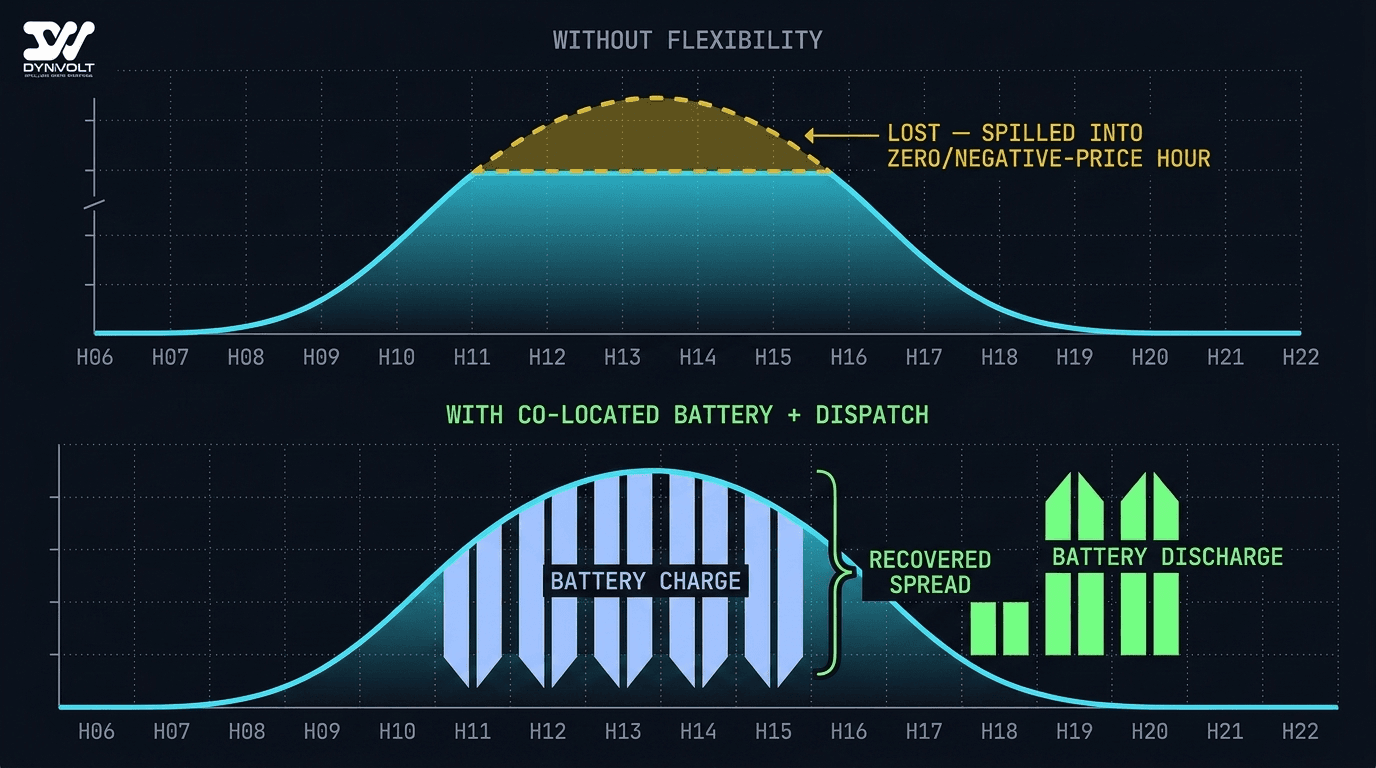
A battery sited behind the same connection point is the direct antidote to economic curtailment and to a useful slice of network curtailment. The mechanism is simple: in the oversupplied, low-or-negative-price midday window, the battery charges from the energy that would otherwise be curtailed; in the evening price peak, it discharges. The curtailed MWh is not lost — it is time-shifted to a higher-value hour, and the spread between the two is the revenue.
The size of the prize is the daily price spread, not the curtailment volume alone. In a zone where midday prices touch zero and the evening peak runs at, indicatively, €120–150/MWh, every MWh the battery shifts is worth the full peak price minus round-trip losses — energy that, un-stored, would have earned nothing or cost money. The constraint is the battery's energy capacity and its cycle budget: a 2-hour battery can only soak two hours of the surplus, and every cycle spent on arbitrage is a cycle not spent on frequency response. This is precisely the trade-off an EMS dispatch optimiser exists to resolve — allocating each cycle to its highest-value use across arbitrage, ancillary services, and curtailment-soak.
For network curtailment, the battery only helps if it sits behind the binding constraint and can later discharge when the constraint relaxes. A battery on the wrong side of a congested line — or one whose discharge re-hits the same thermal limit — recovers nothing. Siting and the constraint topology decide whether the storage is a curtailment solution or just an arbitrage asset.
2. Smart inverters and granular setpoint control
Curtailment does not have to be all-or-nothing. Modern inverters accept continuous active-power setpoints, so a plant can be trimmed to exactly the network's headroom instead of tripped to zero. Combined with reactive-power control to hold voltage in band, fine-grained setpoint following lets a plant ride the edge of a constraint — exporting everything the grid can take rather than over-curtailing to a coarse step. The difference between "curtail to 50% because that's the only setpoint the controller supports" and "curtail to 83% because that's the real headroom" is pure recovered revenue, and it depends on the control layer's resolution and response time.
3. Flexible PPA and offtake structure
The contract shapes who bears curtailment risk and whether the negative-price hours are survivable. Pay-as-produced PPAs pass curtailment volume risk to the buyer; baseload-shaped or fixed-volume PPAs leave the generator exposed to making up the shortfall — sometimes by buying at the very peak prices the curtailment was correlated with. Modern structures address the negative-price problem explicitly: price floors that suspend delivery below zero, or terms that hand the curtailment decision to whoever can act on it most economically. Getting this right at contract signature is worth more than most operational optimisation done afterwards.
4. Co-located flexible load
Where it's available, on-site load — electrolysis, data-centre compute, thermal storage — consumes the surplus locally and never exposes it to the constrained grid or the negative price at all. This is the highest-capex lever and the most site-specific, but for the right host it converts a curtailment liability into a low-cost input for a second revenue line.
A Worked Example: The MEMO Zone
Take a 10 MW merchant solar plant in the MEMO (North Macedonia) day-ahead zone, operating in a regime where network curtailment is uncompensated and the zone is increasingly coupled to the negative-price dynamics of its larger neighbours.
What follows is an illustrative model built from public zone characteristics and stated assumptions — not a customer result. Measured curtailment-revenue attribution is on our measurement roadmap.
The exposure. On a clear summer day the plant produces its peak output from roughly 11:00–15:00. As regional solar penetration has climbed, the day-ahead clearing price in that exact window has fallen — on the worst days, to zero or below. Assume 30 days a year with three midday hours at or below €0/MWh. Without any flexibility, the rational response is economic self-curtailment: stop exporting, because exporting earns nothing or costs money. That is roughly 10 MW × 3 h × 30 days ≈ 900 MWh of energy that the merchant plant simply does not monetise — on top of any uncompensated network curtailment from the same congested summer-midday periods.
The battery case. Add a 5 MW / 10 MWh (2-hour) battery behind the meter. On each of those 30 days, the battery soaks ~10 MWh of the midday surplus — energy that would otherwise be curtailed at €0 — and discharges it into the evening peak. If the evening peak averages €130/MWh and round-trip efficiency is 88%, each shifted MWh is worth ~€114 that the plant earns instead of nothing. Across 30 days that is ~300 MWh shifted (capacity-limited, not volume-limited) at ~€114 ≈ €34,000 recovered from days that, un-stored, contributed zero. Stretch the same logic across all the near-zero-price days in a year — not just the strictly-negative ones — and the curtailment-soak revenue line becomes a material fraction of the battery's business case, layered on top of the arbitrage and ancillary-service revenue it earns on ordinary days.
The modelling lesson. A flat "2% curtailment" assumption applied to this plant's annual yield would have shown a small, benign haircut. The reality is concentrated in specific hours, coupled to price, and either a direct loss (uncompensated network curtailment) or a recoverable opportunity (economic curtailment + storage). The flat assumption is wrong in both directions at once — it understates the merchant pain and ignores the storage upside. Only an hourly, price-coupled model surfaces both.
Modelling Curtailment Honestly: A Checklist
Before the financing model is locked, the curtailment treatment should answer all of the following. Vague answers here are where solar business cases quietly go wrong.
- Is curtailment modelled hourly, against a price and a constraint series — or as a flat annual percentage? If it's flat, it's wrong; the only question is by how much.
- Which curtailment is network and which is economic? They have different compensation and different mitigation. Model them as separate series.
- What is the compensation regime for network curtailment in this zone, today and under the plausible regulatory trajectory? Uncompensated regimes are a direct revenue hit.
- How many hours per year does the model assume at or below €0/MWh, and is that trajectory escalated with regional solar penetration? Static negative-price counts understate the back years.
- Does the battery (if any) sit behind the binding network constraint? If not, it recovers economic curtailment only, not network curtailment.
- Is the battery's curtailment-soak revenue modelled against its cycle budget? A cycle spent soaking is a cycle not earning ancillary-service revenue — the optimiser must arbitrate, and the model must reflect the trade-off.
- What curtailment risk does the PPA pass through, and what happens to the position in a sustained negative-price window? This is a contract question with a large number attached.
- What setpoint resolution does the plant controller support? Coarse curtailment steps over-spill; fine setpoint following recovers the headroom between steps.
Frequently Asked Questions
Conclusion
Curtailment is no longer the small, benign haircut that solar financial models still tend to assume. In high-penetration and coupled markets it is a steepening, hour-concentrated, increasingly price-driven feature of the revenue stack — and the plants that treat it as a flat annual percentage are mispricing exactly the hours that decide the merchant return.
The reframe that matters is this: forced network curtailment is a loss to be modelled and, where possible, sited around; economic curtailment is a price signal to be acted on, not a loss to be suffered. A plant with a co-located battery, granular inverter control, a curtailment-aware offtake contract, and a dispatch layer that arbitrates cycles across arbitrage, ancillary services, and curtailment-soak does not spill its midday surplus into a zero-price hour. It moves it into the evening peak and sells it at a premium. The curtailed MWh becomes a revenue stream rather than a write-off — but only for the operator who modelled it as an hourly, price-coupled reality from the start.
DYNVOLT models curtailment the way the market actually delivers it — hour by hour, coupled to price, split between network and economic causes — and turns it into dispatch decisions. The markets layer couples day-ahead price signals to the forecasting stack (intraday is in active development), and the BESS dispatch optimiser allocates dispatch across arbitrage and curtailment-soak inside hard cycle, depth-of-discharge, rate and thermal constraints, with cycle-cost-aware objectives and ancillary participation as the next milestones. See the architecture overview or request a 90-day pilot to model your own plant's curtailment exposure against a battery business case.